






How Motion Detection CCTV Cameras Work in Practice

Key Takeaways
Motion detection CCTV cameras only deliver real security value when correctly configured with detection zones, calibrated sensitivity, and analytics suited to the environment.
- Most motion detection problems stem from misconfiguration, not faulty hardware — adjusting sensitivity, refining detection zones, or repositioning the camera resolves the majority of false alert issues without replacing equipment.
- Detection zone mapping is more effective than full-frame motion detection in any complex environment, limiting triggers to specific areas like a driveway approach while excluding roads, hedges, and neighbouring properties.
- Smart motion recording with scheduling and line-crossing logic gives property owners and businesses meaningful control, allowing higher sensitivity outside operating hours without generating constant alerts during the day.
- Without analytics or infrared illumination, most cameras cannot reliably distinguish a person from an animal, slow movement may go undetected, and alerts routinely ignored offer no real security benefit.
- Professional-grade equipment from specialist distributors supports configurable detection zones, sensitivity scheduling, and firmware analytics — capabilities often absent from consumer-grade alternatives that limit what configuration can achieve.
Motion detection CCTV cameras are one of the most widely used security technologies in the UK, yet they remain one of the most frequently misconfigured. With an estimated 7 million-plus CCTV cameras now installed across the country (roughly one for every eleven people, according to Clarion Security Systems research), the hardware is clearly in place. Whether it is working correctly is a different question entirely. For property owners and business operators across Manchester and the wider Greater Manchester area, understanding how motion-triggered surveillance actually functions is the first step toward getting genuine value from it.
This article is part of a broader look at CCTV camera features explained, focusing specifically on how motion detection operates, why it so often causes frustration, and what a well-configured system looks like in practice. Dedicated coverage of human detection CCTV cameras and vehicle detection security cameras sits in separate articles within this series, but the principles discussed here underpin both of those more specialised topics.
What Motion Detection CCTV Cameras Actually Do
Motion detection works by comparing successive video frames and identifying pixel-level changes between them. When the difference between two frames crosses a defined threshold, the system logs it as movement and responds by starting a recording clip, sending a push notification, or triggering an alarm. This approach, known as background subtraction, forms the basis of most commercially available smart motion recording systems and works well when calibrated correctly.
More capable systems go beyond basic pixel comparison. Intelligent video analytics use deep learning to classify what caused the movement, distinguishing a person from a shadow, a vehicle from a blowing bin bag, or a genuine intrusion from a swaying branch. This matters enormously for reliability. Basic pixel-change detection responds to anything that moves; analytics-driven detection can be trained to respond only to what matters.
Research published via PubMed demonstrated that pairing a trigger camera with an auto-zoom focus camera improved image resolution and helped law enforcement identify suspects, a practical illustration of how smarter motion-triggered surveillance outperforms passive, continuous footage.
Motion Detection vs Continuous Recording
Continuous recording captures everything but generates enormous amounts of footage that is difficult to review and expensive to store. Motion-triggered recording focuses storage and attention on events that actually warranted a response. For most homeowners and smaller business sites, whether in Salford, Stockport, or the city centre, motion-triggered surveillance is the more practical and cost-effective approach, provided the system is configured to catch what it should.
Why CCTV Motion Alerts Cause Problems
False alerts are the most common frustration with motion detection CCTV cameras. Most problems trace back to three causes: sensitivity set too broadly, cameras positioned without accounting for background movement, and detection zones covering far more of the frame than necessary. Any combination of these produces a high volume of false triggers, which quickly trains users to ignore alerts and defeats the purpose of having them.
Lighting is a particularly overlooked factor. Sunrise and sunset produce gradual but measurable changes across an entire camera frame, which basic pixel-comparison systems can read as sustained movement. A camera pointing toward a busy road, as is common on many Manchester commercial properties, will fire an alert every time a vehicle passes if no zone exclusions are set. A garden-facing camera without species filtering will respond to every cat, fox, or bird that crosses the lens.
A reliable indicator of poor system performance: if alerts are routinely dismissed without review, or the camera log shows dozens of clips with nothing of interest, the configuration needs attention. In many cases, adjusting sensitivity, refining detection zones, or repositioning the camera resolves the issue without replacing any equipment.
How to Configure Smart Motion Recording
Smart motion recording gives users meaningful control over when and how the system responds to movement. Most professional-grade NVRs and camera systems allow for scheduling, so a camera covering a business entrance can be set to higher sensitivity outside operating hours without generating alerts throughout the working day. Sensitivity thresholds can be adjusted independently per camera and, on capable systems, per zone within the frame.
Line-crossing detection and intrusion zone features take this further. Rather than responding to any movement anywhere in the frame, these tools let you draw virtual boundaries. An alert fires only when an object crosses a defined line or enters a defined area and, if needed, only when travelling in a specific direction. This is considerably more precise than full-frame detection and significantly reduces the noise that makes so many systems unreliable.
What Sensitivity Settings Actually Control
Sensitivity settings determine how large a pixel change needs to be before the system registers movement. Set too high, and the camera triggers on minor variations such as light reflections, distant traffic, or a flag in the wind. Set too low, and a person walking slowly through the frame may not register at all.
Research published via PMC found that intense human motion associated with criminal activity produces distinct patterns, including rapid change, large amplitude, and irregularity, which suggests that well-calibrated sensitivity thresholds can help distinguish deliberate intrusion from background noise. A practical starting point for most environments is a lower-to-mid sensitivity setting, with detection zones tightened rather than sensitivity pushed high to compensate for poor camera placement.
Detection Zones vs Full-Frame Motion Detection
Full-frame motion detection applies trigger logic to every pixel in the image simultaneously. In any environment with visual complexity, such as trees, passing traffic, or shifting light, this produces constant false alerts. Detection zone mapping solves this by limiting the active trigger area to specific parts of the frame.
A driveway camera, for example, might have a zone drawn only across the approach path to the building, excluding the road, the hedge, and the neighbour’s garden entirely. This single adjustment often eliminates the majority of false alerts on domestic and small business installations across Manchester, without any change to sensitivity levels.
Basic Motion Detection vs Intelligent Video Analytics
| Feature | Basic Motion Detection | Intelligent Video Analytics |
|---|---|---|
| Trigger method | Pixel-level change between frames | Deep learning classification of movement source |
| Distinguishes people from animals | No | Yes |
| Distinguishes vehicles from debris | No | Yes |
| False alert rate | High in complex environments | Significantly lower |
| Detection zone support | Varies by system | Yes, typically per zone |
| Sensitivity scheduling | Limited or unavailable | Available on professional-grade systems |
| Suitable for complex environments | Only with careful placement | Yes |
Motion Detection Requirements by Property Type in Manchester
Detection needs vary considerably depending on the site. Typical requirements differ as follows:
- Domestic driveway: Compact zone covering the gate-to-door path; lower sensitivity to avoid triggering on passing traffic or neighbours.
- Retail shopfloor: Detection that distinguishes staff movement during the day from unscheduled presence at night; schedule-based sensitivity changes recommended.
- Warehouse entrance: Vehicle detection capable of differentiating an expected delivery from an unauthorised vehicle arriving outside hours.
- Office car park: Perimeter line-crossing detection combined with intrusion zones around high-value areas such as server rooms or plant rooms.
Motion Detection Configuration by Property Type in Manchester
| Property Type | Recommended Detection Approach | Key Configuration Priority |
|---|---|---|
| Domestic driveway | Compact zone on gate-to-door path | Lower sensitivity; exclude road and neighbouring properties |
| Retail shopfloor | Schedule-based sensitivity changes | Higher sensitivity outside operating hours; lower during business day |
| Warehouse entrance | Vehicle detection with analytics | Differentiate expected deliveries from unauthorised vehicles outside hours |
| Office car park | Perimeter line-crossing and intrusion zones | Focus zones on high-value areas such as server rooms or plant rooms |
A one-size-fits-all approach rarely performs well across these environments. Whether you are securing a terraced property in Didsbury, a retail unit in the Northern Quarter, or an industrial site in Trafford Park, physical layout, lighting conditions, expected movement patterns, and response requirements all differ. Professional configuration, rather than applying factory defaults, is the baseline expectation for any system that needs to be genuinely reliable.
The 40-year systematic CCTV meta-analysis published via ResearchGate noted that within analytics-assisted systems, the human operator’s role shifts from manually scanning footage to supervising motion-triggered alerts and making response decisions, a shift that only works if those alerts are meaningful.
Realistic Limitations of Motion Detection CCTV
Motion detection CCTV cameras are a powerful tool, but they work within real constraints worth understanding before relying on alerts:
- Complete darkness: Without infrared illumination, most cameras cannot reliably detect movement, as there is no pixel data worth comparing.
- Slow movement: Someone edging along a wall may fall below the change threshold even at moderate sensitivity settings.
- No analytics: Without human detection functionality, most systems cannot reliably distinguish a person from an animal, a vehicle, or wind-blown material.
The evidence base for CCTV effectiveness is strong. The College of Policing reports that drug-related crimes decreased by 20% and vehicle and property crime decreased by 14% in locations with CCTV compared to those without. Those outcomes depend on systems being actively monitored or correctly linked to alert mechanisms. A camera generating constant false alerts, or one whose notifications are routinely ignored, is not contributing to those outcomes.
When to Involve a Professional Installer
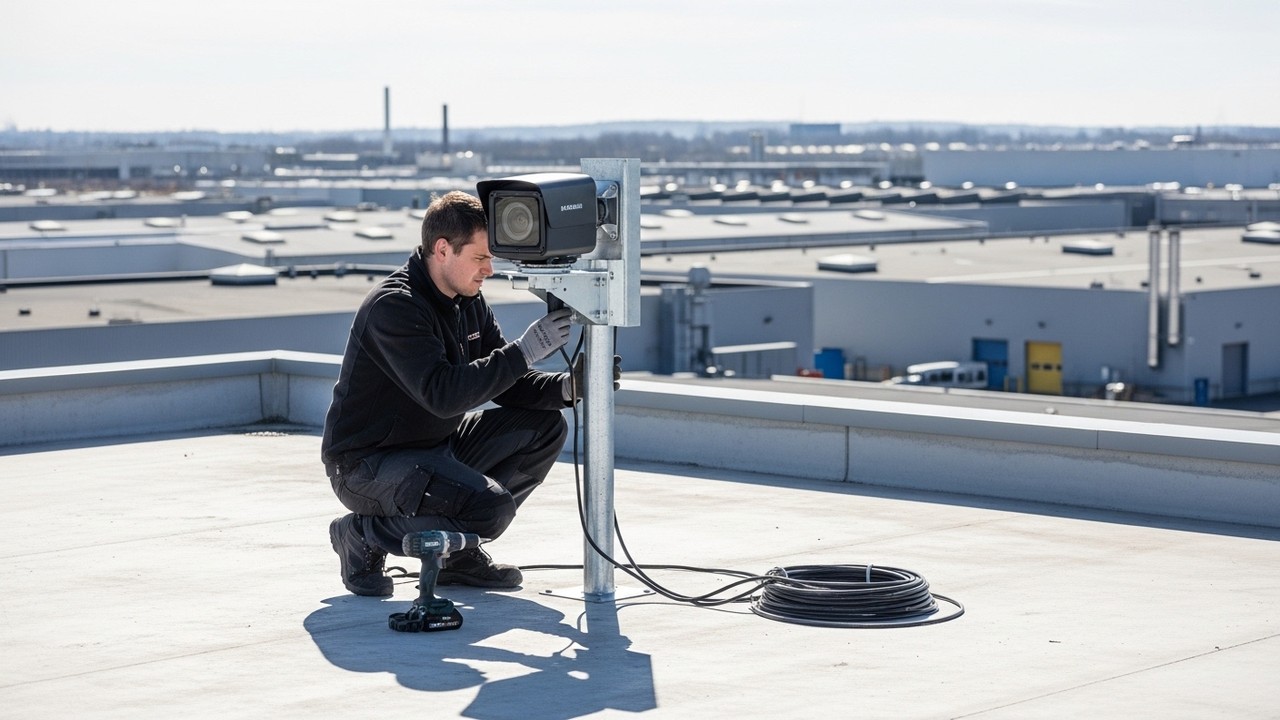
Self-configuration works for straightforward single-camera setups where the environment is simple and the stakes are modest. It becomes insufficient when a site expands beyond a handful of cameras, when CCTV needs to integrate with intruder alarms or access control systems, or when persistent false alert issues have resisted basic adjustments.
At that point, zone mapping, camera interplay, and recorder configuration benefit from someone who works with these systems regularly. For businesses and property owners across Greater Manchester, working with a local specialist means faster support and configuration advice that accounts for the practical realities of local sites.
Equipment quality also determines what is possible. A lower-specification camera may not support detection zones, line-crossing logic, or sensitivity scheduling regardless of how carefully settings are adjusted. Sourcing equipment from a specialist distributor with genuine technical support gives installers and informed buyers access to systems where these features are properly built in and supported.
What to Look for When Choosing Motion Detection CCTV Cameras
When evaluating systems, the key questions to ask are whether the camera supports configurable detection zones, what analytics capabilities are available at firmware level, how the recorder handles alert logs and clip retrieval, and whether the manufacturer provides ongoing firmware support.
Cameras that offer only basic pixel-change detection without zone control or sensitivity scheduling are unlikely to perform well in any environment with visual complexity.
For trade installers and property owners across Manchester making informed purchasing decisions, working with an authorised distributor that carries professional-grade Dahua systems and equivalent technology provides a more dependable starting point than sourcing through general channels. Access to the full product range, accurate specifications, and technical guidance from people who understand real-world configuration makes a meaningful difference, particularly where reliable motion-triggered surveillance is a genuine operational requirement rather than a box-ticking exercise.
If you are specifying a system, reviewing an existing setup that is not performing, or sourcing equipment for a new installation in Manchester or the surrounding area, the team at Knight Security is here to help. Contact us to speak with a dedicated account manager who understands both the products and the practical realities of getting motion detection right.

Frequently Asked Questions
What causes false alerts on motion detection CCTV cameras?
False alerts are most commonly caused by sensitivity settings that are too high, detection zones that cover too much of the frame, and camera placement that captures background movement such as passing traffic, trees, or shifting light. Adjusting zones and lowering sensitivity resolves most issues without replacing hardware.
How do detection zones reduce false motion alerts?
Detection zones restrict the active trigger area to specific parts of the camera’s view. Instead of responding to every pixel change across the full frame, the system only reacts to movement within a defined region such as a doorway or driveway path, which significantly reduces irrelevant alerts from surrounding activity.
Can motion detection CCTV cameras work in complete darkness?
Not without infrared illumination. In total darkness there is insufficient visual data for the camera to compare between frames. Cameras equipped with infrared LEDs or low-light sensors can detect movement at night, but standard cameras without these features will not reliably trigger in dark conditions.
What is the difference between basic motion detection and intelligent video analytics?
Basic motion detection responds to any pixel-level change between video frames regardless of what caused it. Intelligent video analytics use deep learning to classify the source of movement, distinguishing a person from an animal or a vehicle from debris, which reduces false alerts and improves the relevance of recorded events.
When should a professional installer configure motion detection settings?
Professional configuration is advisable when a site has multiple cameras, when CCTV needs to integrate with alarms or access control, or when basic adjustments have not resolved persistent false alerts. A specialist can map detection zones accurately, configure schedules per camera, and ensure the system responds reliably to genuine events.