






How Starlight CCTV Camera Technology Works in Low Light

Key Takeaways
Starlight CCTV camera technology captures full colour footage in near darkness by combining large sensors, wide apertures, and advanced processing to use available ambient light.
- Starlight CCTV camera technology works by amplifying existing ambient light rather than projecting infrared, which is why it produces full colour footage where standard cameras switch to black and white.
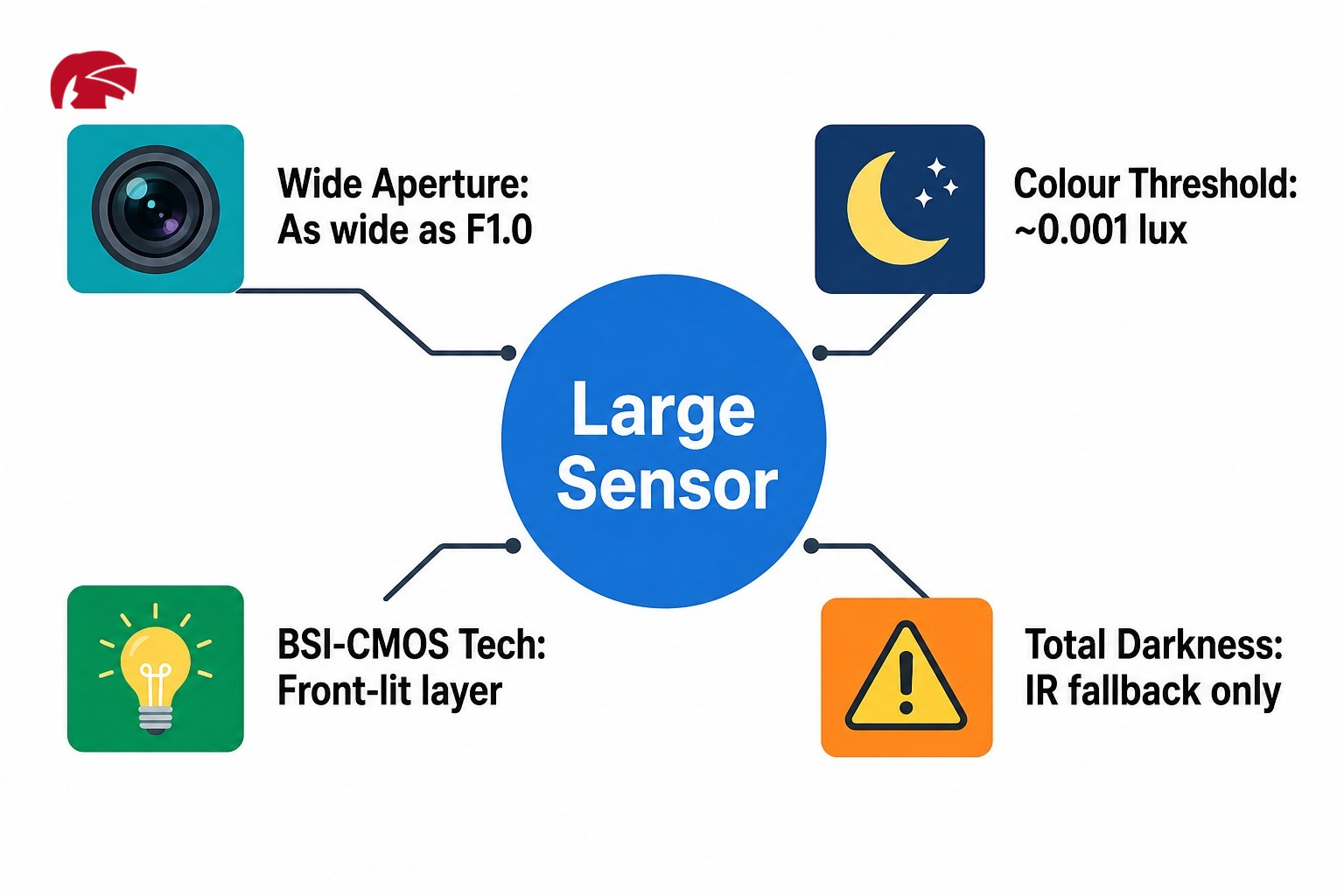
- The key hardware factors behind dark scene camera performance are sensor size, lens aperture, and pixel design. Wider apertures such as F1.0 and larger sensors allow significantly more light to reach the image processor.
- Lux ratings tell you how little light a camera needs to function. Some starlight cameras capture colour images at 0.001 lux, making them suitable for environments like unlit loading bays, stairwells, and rural perimeters.
- The enhanced night image sensor used in starlight cameras, known as BSI CMOS, positions the light gathering layer at the front of the sensor structure, removing interference from wiring and improving low light sensitivity.
- Before selecting a starlight camera, verify the minimum illumination rating, lens aperture, low light resolution, infrared fallback capability, and compatibility with your existing recording and management software.
If you have ever reviewed overnight footage from a standard CCTV camera and been left with a grainy, washed-out image that tells you very little, you are not alone. Most conventional cameras struggle in the dark, and that is precisely where starlight CCTV camera technology was designed to step in. Rather than flooding a scene with infrared light and producing black-and-white footage, starlight cameras are engineered to extract usable, full-colour images from the ambient light already present, whether that is the faint glow of a distant streetlamp or the low-level lighting inside a warehouse at night.
This guide covers the core mechanics behind starlight performance, what the terminology actually means, where it genuinely delivers results, and how to match the right camera to the right environment. Whether you manage a retail unit in Manchester city centre, a logistics site on the outskirts of Salford, or oversee a multi-site commercial operation across Greater Manchester, the principles covered here apply directly to the choices you will face.
What Does Starlight Camera Mean?
The word “starlight” is not a formally regulated technical standard. It originated as a product descriptor used by manufacturers to communicate that a camera could capture usable footage under extremely low ambient light, comparable in principle to the faint illumination of a clear night sky. The problem is that the term has since been applied loosely across product ranges with varying levels of actual performance, making it difficult for buyers to know what they are getting without looking beyond the label.
In a meaningful technical sense, a starlight-grade camera should be capable of producing colour footage at very low lux levels, using a combination of hardware design choices rather than any single component. When a product listing simply carries the word “starlight” without specifying minimum illumination levels, aperture, or sensor size, that label is functioning as a marketing term rather than a specification. Comparing the actual lux rating, lens aperture, and sensor dimensions across products will always give you a more accurate basis for comparison than brand terminology alone.

How Starlight CCTV Cameras Work in Low Light
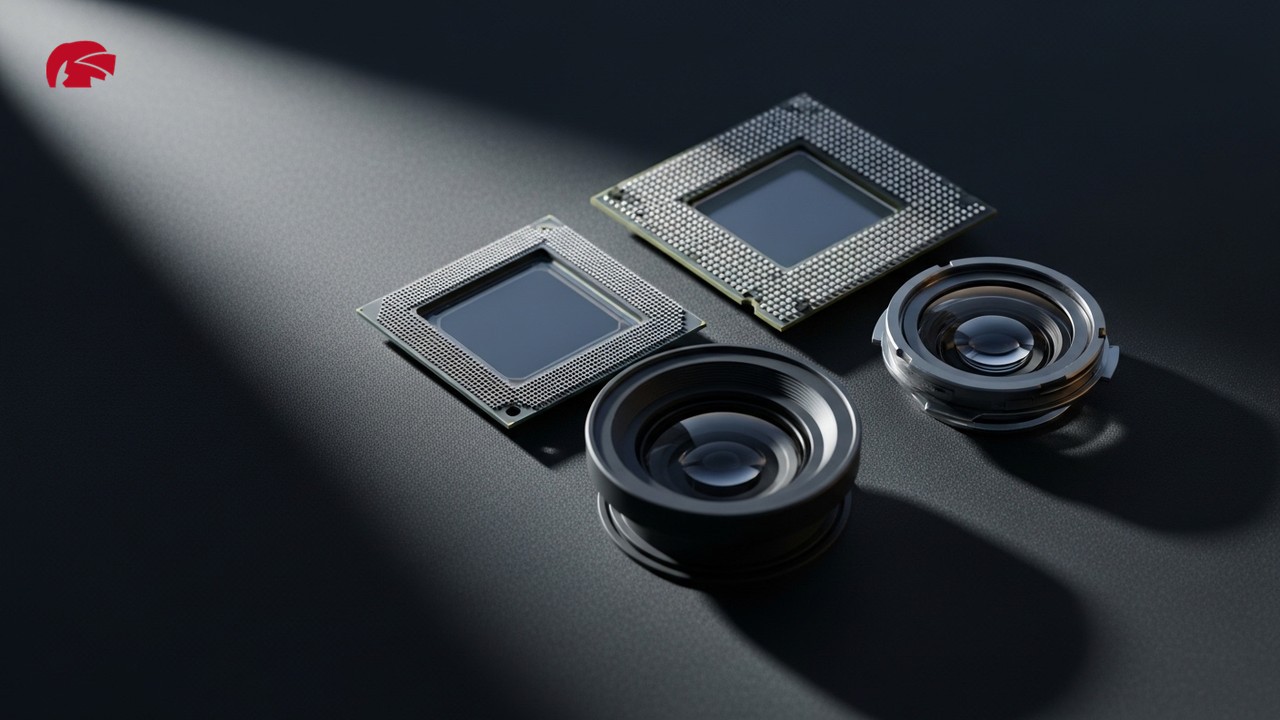
Starlight cameras capture clear footage in near-darkness by combining three key hardware elements: a large image sensor, a wide lens aperture, and precisely engineered pixels. Each plays a distinct role.
- Larger image sensor: Captures more light across a wider area, improving overall sensitivity.
- Wider lens aperture: Allows more light to pass through the lens at any given moment. Starlight cameras can feature apertures as wide as F1.0 and sensors as large as 1/1.8 inches.
- Larger pixels: Convert incoming light into cleaner image data with less visual noise.
Beyond the physical hardware, real-time noise reduction algorithms clean up the signal to produce sharper, more usable footage. Slower shutter speeds can also be applied to collect more light per frame, though this can introduce motion blur when fast-moving subjects are involved. These trade-offs are important to understand when choosing a camera for environments where vehicles or pedestrians are the primary subject.
What Low Lux Ratings Mean for Night Vision
Lux measures the amount of light falling on a surface. The lower a camera’s minimum lux rating, the less light it needs to produce a usable image. Common reference points include:
- 300 to 500 lux: Bright office environment
- 10 to 50 lux: Well-lit car park at night
- 0.1 lux: Moonlight on a clear night
- Below 0.1 lux: Unlit corridor or enclosed yard
Some low lux surveillance cameras can capture colour images at levels as low as 0.001 lux. At the highest end of the market, certain starlight cameras can capture 1080p monochrome images at just 0.000275 lux. These figures translate abstract specifications into practical guidance about which environments a camera can genuinely handle.
| Light Level | Lux Range | Typical Environment |
|---|---|---|
| Bright indoor | 300 to 500 lux | Office or retail floor |
| Lit outdoor at night | 10 to 50 lux | Well-lit car park |
| Moonlight | ~0.1 lux | Clear night outdoors |
| Very low ambient | Below 0.1 lux | Unlit corridor or enclosed yard |
| Starlight colour threshold | ~0.001 lux | Near-darkness with trace ambient light |
| Starlight mono threshold | ~0.000275 lux | Extreme low-light at high-end performance |
How a Starlight Sensor Differs from a Standard CCTV Sensor
Standard CCTV cameras use sensors built for broad performance across mixed lighting conditions, with no particular optimisation for darkness. Starlight-grade cameras use sensors engineered specifically to extract maximum signal from minimal available light.
The most common type used in this category is the back-illuminated CMOS sensor, often called BSI-CMOS. In this design, the light-gathering layer sits at the front of the sensor structure, removing the interference caused by wiring circuits that block incoming light in conventional designs. This single change significantly improves low-light sensitivity. Combined with on-chip noise reduction and wider dynamic range processing, a BSI-CMOS sensor can produce footage that a standard camera simply cannot match under the same conditions.
Do Starlight Cameras Use Infrared?
Not necessarily, and this is one of the most important distinctions to understand. Standard infrared night vision cameras project invisible infrared light onto a scene and capture the reflected signal, which is why their night footage is always black and white. Starlight cameras take a different approach: they amplify the visible light already present in the scene, which is why they can deliver full-colour footage in conditions where an infrared camera would switch to monochrome.
The transition between day and night modes is managed by an IR cut filter (often called an ICR filter), which sits in the camera’s optical path. During daylight, it blocks infrared wavelengths that would distort colour accuracy. When light drops below a usable threshold, the camera automatically removes the filter to allow all available light, including near-infrared, to reach the sensor. If the camera also includes a built-in infrared illuminator, it activates at this point. If it does not, the camera continues operating on ambient light alone. For a broader comparison, see our guide to night vision CCTV cameras explained and our breakdown of infrared vs colour night vision.
Where Starlight Cameras Perform Well and Where They Have Limits
Starlight CCTV camera technology delivers genuine improvements across a wide range of real-world conditions: dimly lit car parks, building entrances with partial street lighting, covered loading bays, and retail spaces where interior lighting is reduced overnight. Its adoption spans parking and hotel monitoring through to industrial and high-security applications, reflecting the breadth of its performance in the field.
In Greater Manchester specifically, this performance is relevant across covered NCP car parks, Trafford Park industrial units, late-night retail frontages, and residential developments in areas such as Didsbury, Chorlton, and Salford Quays, where ambient lighting levels can vary considerably from one street to the next.
However, there are clear limits to be aware of:
- Total darkness: With no ambient light at all, starlight cameras will either switch to infrared mode (if supported) or produce degraded image quality.
- Direct glare: Bright headlights or floodlights can cause overexposure and wash out nearby detail.
- Lens fogging: Damp or cold environments, a common consideration during Manchester winters, can reduce image clarity regardless of sensor quality.
- High-contrast scenes: Where a brightly lit area sits directly next to a very dark one, accurately rendering both in the same frame is challenging.
Setting realistic expectations around these conditions is important when specifying a system, because no single camera resolves every low-light challenge in every environment.
| Condition | Starlight Performance | Notes |
|---|---|---|
| Dimly lit car parks | Good | Performs well with trace ambient or street lighting |
| Building entrances with partial street lighting | Good | Colour detail typically retained |
| Covered loading bays | Good | Suitable where some emergency or spill lighting is present |
| Retail spaces with reduced overnight lighting | Good | Interior ambient light supports colour output |
| Total darkness | Limited | Switches to IR mode if supported; otherwise image degrades |
| Direct glare from headlights or floodlights | Limited | Overexposure can wash out nearby detail |
| Cold or damp environments | Variable | Lens fogging can reduce clarity regardless of sensor quality |
| High-contrast scenes | Challenging | Rendering bright and dark areas in the same frame is difficult |
How to Choose the Right Starlight Camera for Your Property
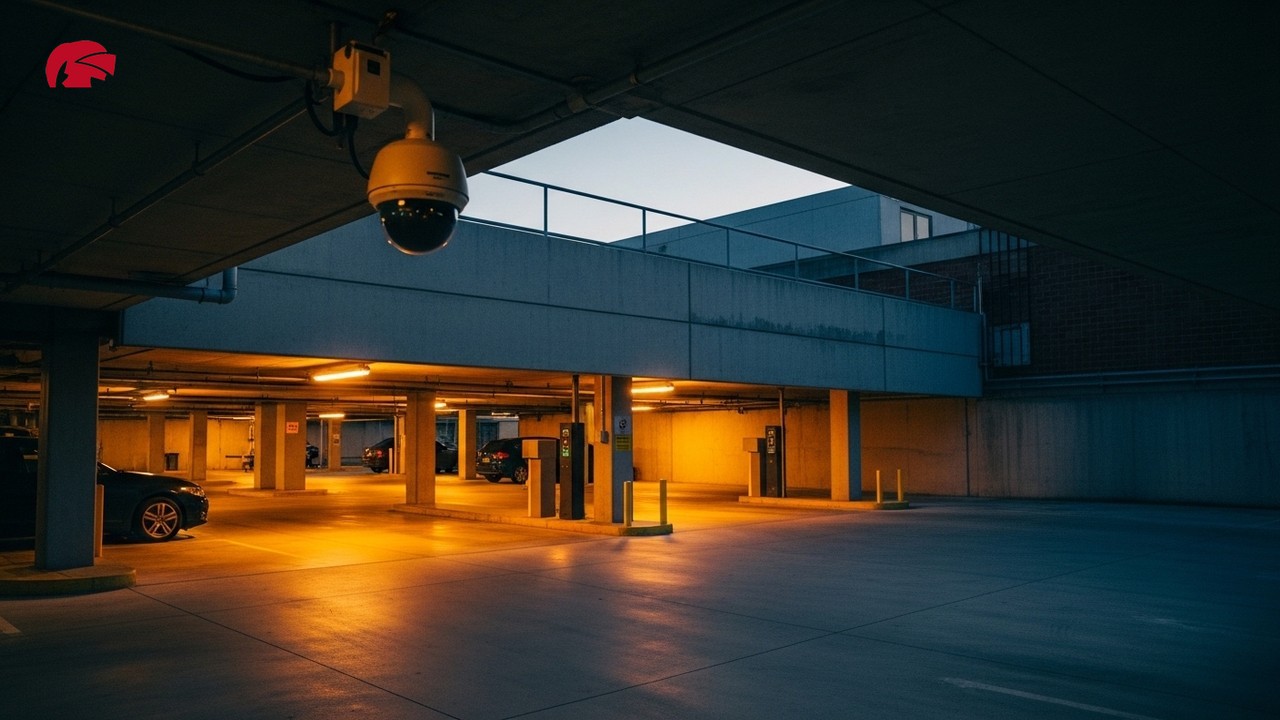
Matching a camera’s specification to the actual lighting conditions of your site is the most critical step in the selection process. A residential driveway with nearby street lighting presents a very different challenge to an unlit industrial perimeter or a covered multi-storey car park with only emergency lighting active overnight.
As a general guide:
- Building entrances and retail frontages in urban areas: A minimum illumination rating of around 0.01 lux with a wide aperture lens will typically perform well.
- Darker environments such as warehouses, rural perimeters, and internal stairwells: A lower lux threshold and a larger sensor format become increasingly important.
- Sites where movement capture is a priority: Certain starlight cameras can capture moving objects at up to 30 frames per second in low-light conditions, a useful benchmark to ask about when comparing products.
It is also worth confirming how the camera integrates with your existing recording equipment. Higher-resolution starlight sensors produce larger file sizes, which affects storage requirements on NVRs and DVRs. Compatibility with your recorder, network infrastructure, and video management software should always be verified before committing to a specification, particularly on larger or multi-camera installations.
Key Questions to Ask Before Buying a Starlight CCTV Camera
Before finalising your choice, work through these checks to confirm the specification matches both your site and your installation requirements:
- What is the camera’s minimum illumination rating in lux, and does it match the lowest expected light level at the target location?
- What is the lens aperture, and does the camera support variable or interchangeable lenses for the required field of view?
- What resolution does the camera produce specifically in low-light conditions, not only in standard daylight?
- Does the camera include a built-in infrared illuminator as a fallback, or does it rely entirely on ambient light?
- Is the camera compatible with the existing NVR, DVR, or VMS software already in use on your site?
How Knight Security Supports Trade Customers with Starlight Camera Specification
For installers and integrators working across Greater Manchester and the wider UK, Knight Security provides trade-only access to professional starlight-range products, including the Dahua starlight camera lineup, one of the most established and technically documented ranges available to UK security professionals. As an authorised Dahua distributor, Knight Security can provide product-level technical guidance to help match the right camera specification to the actual demands of each installation, whether that is a single-site retail unit in Manchester city centre or a multi-building commercial project spanning several sites across the region.
Every approved trade customer is assigned a dedicated account manager who can assist with specification queries, compatibility checks, and project-specific procurement. Products are available through a secure trade portal with transparent pricing, no time-limited promotions, and next-day delivery on over 2,000 in-stock lines. If you are working on a project where low-light camera performance is a critical factor, get in touch with the Knight Security trade team to discuss the right specification for your installation.
Frequently Asked Questions About Starlight CCTV Camera Technology
What is the difference between a starlight camera and a standard CCTV camera?
A starlight camera uses a larger sensor, wider aperture lens, and BSI-CMOS technology to capture colour footage in near-darkness using existing ambient light. A standard CCTV camera is optimised for general lighting conditions and typically switches to black-and-white infrared mode at night, producing less detail in low-light scenes.
Can a starlight camera work in complete darkness?
No. Starlight cameras require some ambient light to produce colour footage. In total darkness, a camera with a built-in infrared illuminator will switch to monochrome IR mode. A camera without IR support will produce degraded or unusable images. For fully unlit environments, an IR-equipped starlight camera is the more practical choice.
What lux rating should I look for in a starlight CCTV camera?
For most urban or suburban UK installations, including car parks, building entrances, and retail frontages, a minimum illumination rating of around 0.01 lux is a reasonable baseline. For darker environments such as warehouses or rural perimeters, look for ratings of 0.001 lux or lower, paired with a wide aperture lens such as F1.2 or F1.0.
Do starlight cameras record in colour at night?
Yes, provided there is sufficient ambient light. Starlight cameras are designed to maintain colour output in low-lux conditions where standard cameras would switch to black and white. In very low light without infrared support, image quality may degrade, but colour retention in partial lighting is a core feature of starlight technology.
Are starlight cameras suitable for residential properties as well as commercial sites?
Yes. Starlight cameras are used across both residential and commercial applications. For a home with a driveway or garden covered by street lighting, a starlight camera will typically outperform a standard IR camera in terms of detail and colour accuracy. For commercial sites with larger dark areas, pairing starlight cameras with appropriate supplementary lighting often gives the best results.
Does a starlight camera need special recording equipment?
Not necessarily, but compatibility should be verified before purchase. Higher-resolution starlight cameras generate larger video files, which can affect NVR or DVR storage capacity and network bandwidth. Confirming that the camera’s output format, resolution, and compression standard are supported by your existing recorder or video management software is an important step before committing to a specification.
