






Infrared or Colour Night Vision: Which Fits Your Manchester Property?

Key Takeaways
Choosing between infrared and colour night vision depends on your property lighting conditions, not just camera specs, so matching technology to environment is the key decision.
- Infrared cameras work best in total darkness and unlit outdoor areas such as rear gates, side passages, and rural boundaries, offering reliable monochrome footage without any visible light source.
- Full colour night cameras use white light LEDs to produce colour rich footage that makes identifying clothing, faces, and vehicle registrations far easier, which is especially valuable for car parks, shop fronts, and access points.
- White light illumination acts as a visible deterrent as well as a recording tool, making white light security cameras a practical choice for locations where deterrence and evidence quality are both priorities.
- Night vision image quality is shaped by lens choice, camera placement, sensor size, and viewing angle as much as by the technology type itself, so installation planning and product selection should always be developed together.
- Larger or mixed use sites often benefit from combining both technologies, with infrared covering perimeter and low traffic zones and colour cameras handling entry points and areas where detailed identification matters most.
When planning a CCTV system, one of the most practical decisions you will face is choosing between infrared and colour night vision. Both technologies work after dark, both are widely available, and both have a genuine place in home and business security. The real question is not which one is better overall. It is which one suits the specific conditions around your property. Get that match right and your cameras will consistently capture usable footage. Get it wrong and even a well-specified system can leave you with images that are too dark, washed out, or short on the detail you need when it matters most.
This guide explains how each technology works, where each performs best, and how to match your choice to real property types and lighting conditions. It sits within the broader subject of night vision CCTV cameras explained, covering the practical comparison that matters most before you buy or specify any camera.
The Core Difference Between Infrared and Colour Night Vision
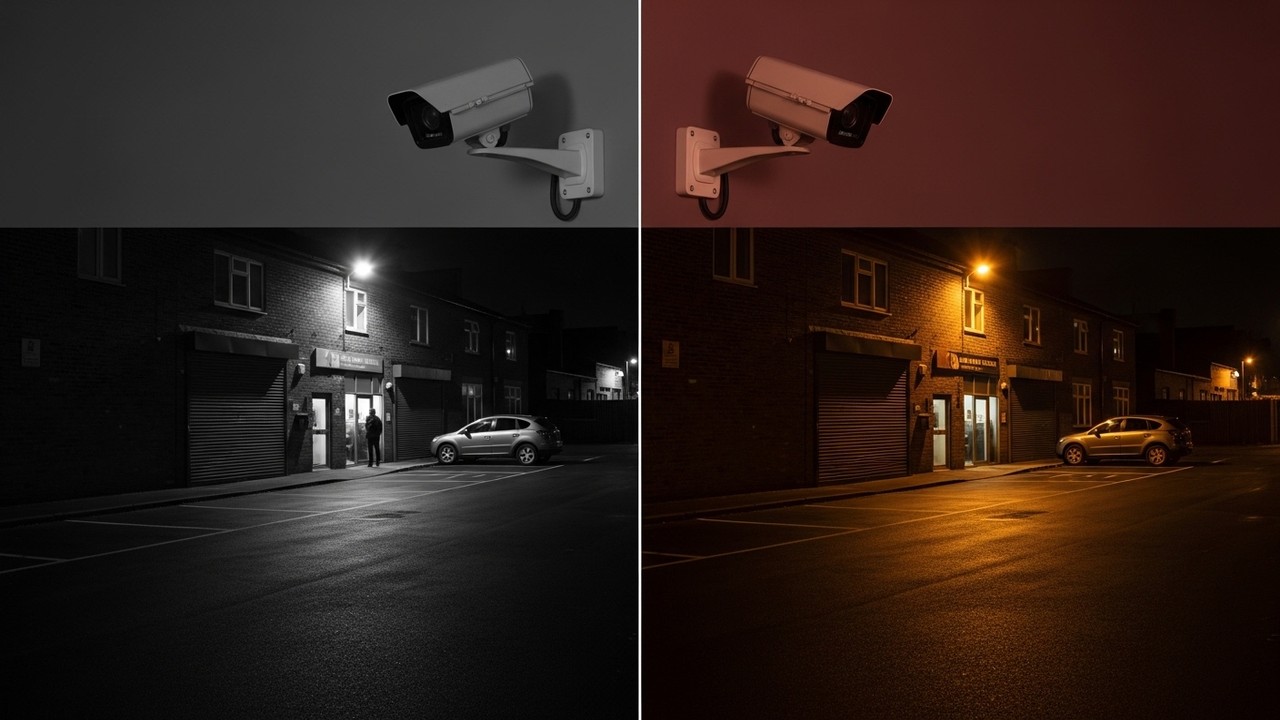
Infrared (IR) night vision cameras illuminate a scene using light beyond the visible spectrum, producing clear black-and-white footage in complete darkness with no visible glow. Colour night vision cameras use built-in white light LEDs to flood an area with visible light, capturing full-colour footage similar to daytime quality. The key difference comes down to visibility: IR cameras are discreet, while colour cameras are visible but can also act as a deterrent.
Infrared vs Colour Night Vision: Key Differences at a Glance
| Feature | Infrared (IR) Night Vision | Full Colour Night Vision |
|---|---|---|
| Illumination type | Invisible infrared light (700 to 1,000 nm) | Visible white light LEDs |
| Footage colour | Black and white (monochrome) | Full colour |
| Visible to bystanders | No | Yes |
| Deterrent effect | Low (discreet) | High (visible presence) |
| Performance in total darkness | High | Depends on LED range |
| Detail for identification | Medium (no colour cues) | High (clothing, plates, faces) |
| Typical cost | Lower | Higher |
| Storage demand | Lower | Higher |
Why Your Lighting Environment Matters More Than Camera Specification
It is tempting to focus on resolution or brand reputation when choosing security equipment. But the single biggest influence on night vision image quality is the environment the camera is placed in. A high-resolution camera with the wrong night vision technology for its location will consistently underperform compared to a well-matched mid-range option.
Before comparing products, assess what you are actually working with:
- How much ambient light is present after dark
- Whether that light is consistent or variable throughout the night
- Whether any existing lighting can be relied upon or adjusted
Properties in Greater Manchester vary considerably in this respect. A commercial premises on a well-lit high street in Salford or Stockport behaves very differently from an industrial unit on the outskirts of Trafford or a residential property down an unlit back lane in a quieter suburb. Real-world performance is determined by conditions on the ground, not just numbers on a product sheet.
How Infrared Night Vision Works
Infrared cameras illuminate a scene using light in the 700 to 1,000 nanometre spectral range, beyond what the human eye can detect. According to research published in the International Journal for Research in Applied Science and Engineering Technology, active infrared night vision combines IR illumination with sensors sensitive to that spectral band. This is why IR camera footage appears in monochrome: the sensor captures reflected IR light, but because it operates on a single spectrum, it cannot resolve colour information. The result is a clear, detailed black-and-white image even in complete darkness, with no visible light source apparent to anyone nearby.
This combination of invisibility and reliability in total darkness makes infrared the stronger choice in specific situations:
- Locations that are genuinely unlit at night
- Areas where a visible light source would be disruptive or draw unwanted attention
- Low-traffic outdoor zones such as rear access gates, side passages, or rural boundaries
The technology has decades of maturity behind it, which contributes to its general availability and lower cost compared to newer alternatives.
IR Range and Coverage Limitations
Most home and commercial IR cameras cover between 10 and 30 metres in complete darkness. However, range alone does not tell the full story. Two common limitations to plan for:
- Overexposure at close range: The intensity of IR illumination can cause nearby subjects to appear washed out or bleached.
- Reflective surfaces: Licence plates, white walls, and glass can reflect IR light so strongly that detail is lost entirely, leaving a bright white area in the image.
Understanding these limitations is important when planning camera placement, especially where vehicles pass close to the camera or where building materials are highly reflective.
How Full Colour Night Vision Works
Full colour night cameras use built-in white light LEDs to illuminate the area, allowing the sensor to capture full-colour footage in low-light or dark conditions. The result closely resembles daytime footage in terms of colour accuracy.
This makes a meaningful difference when reviewing incidents. Identifying a person by their clothing colour, reading a vehicle registration plate, or matching a face to a description all become significantly easier with colour footage compared to monochrome IR images.
The trade-off is visibility: anyone near a white light security camera will see the illumination when the LEDs are active. Full colour cameras, especially those with quality starlight CCTV sensor technology, also tend to cost more than IR models. Continuous 24-hour colour recording demands greater storage capacity than black-and-white IR footage, a factor worth accounting for in total cost of ownership.
When White Light Security Cameras Make Practical Sense
The visibility of white light is not always a drawback. In many locations it actively deters opportunistic behaviour. White light security cameras work well in the following environments:
- Car parks and external parking areas where colour detail on vehicles is a priority for evidence and incident review
- Retail entrances and shopfronts where facial identification and clothing colour are needed for investigations
- Access gates and controlled entry points where visible illumination reinforces the deterrent effect
- Covered or partially lit areas where some ambient light is already present, helping the sensor perform at its best
Matching the Technology to Your Manchester Property
Mapping each technology to realistic scenarios makes the decision much clearer than comparing specifications in isolation.
- Residential driveways with no street lighting: IR is the practical default. It works reliably in total darkness, causes no visible disturbance, and covers typical distances without additional infrastructure.
- Shop fronts on active streets: A full colour camera often delivers more usable evidence footage because colour detail is what investigators and insurance assessors actually need. This applies particularly to busy retail locations across Manchester city centre, Didsbury, or Chorlton.
- Warehouse perimeters: Large open areas with long sight lines, such as industrial estates in Trafford Park, may benefit from extended-range IR cameras. Loading bays and entry points where close-range identification matters are often better served by white light colour cameras.
- Office car parks: This is often the clearest case for colour night vision, particularly where vehicle registration and clothing colour are relevant to access disputes or theft incidents.
Technology Recommendation by Property Type and Lighting Condition
| Property / Location | Typical Lighting Condition | Recommended Technology | Primary Reason |
|---|---|---|---|
| Residential driveway | No street lighting | Infrared (IR) | Reliable in total darkness, discreet, lower cost |
| Shop front / retail entrance | Well-lit street | Full colour | Colour detail needed for evidence and identification |
| Warehouse perimeter | Minimal or no lighting | Infrared (IR) | Extended range coverage across large open areas |
| Loading bay / entry point | Partial or variable lighting | Full colour | Close-range identification of people and vehicles |
| Office car park | Partial lighting | Full colour | Vehicle registration and clothing colour for incident review |
| Rear access gate / side passage | No lighting | Infrared (IR) | Discreet coverage where visible light would be intrusive |
Grounding the decision in what the footage will actually be used for is the most reliable framework for getting it right.
Other Factors That Shape Night Vision Image Quality
Technology type is not the only variable that shapes what your footage looks like. These factors all play a role:
- Lens quality and focal length: A wide-angle lens placed too high above a doorway may cover the area but fail to resolve facial features at the required distance.
- Camera resolution: Higher resolution only helps when combined with good placement, the right lens, and adequate illumination.
- Sensor size: Larger sensors perform better in low light, capturing more detail with less noise.
- Placement height and angle: A well-positioned mid-range camera will often outperform a high-spec camera mounted at the wrong angle.
Research published by IEEE Spectrum points to an emerging convergence between IR and colour technologies, with deep-learning systems now capable of inferring visible colours from infrared spectral data. This remains at the research stage rather than a mainstream product feature, but it suggests the gap between IR and colour footage may narrow in future camera generations. For current purchasing decisions, placement, lens choice, and technology matching remain the most important factors.
Choosing and Installing the Right Camera Across Greater Manchester
Selecting the right technology is only half the decision. Even a well-specified camera will underperform if it is positioned poorly, angled incorrectly, or deployed without accounting for seasonal lighting changes, obstructions, or competing light sources nearby. The camera specification and the installation plan need to be developed together, not in sequence.
For single-property residential installations, the choice is usually straightforward once the lighting environment is assessed honestly. For larger or mixed-use sites across Greater Manchester, such as a business with a public-facing shopfront, a staff car park, and a rear loading area, the right answer is often a combination of both technologies deployed where each performs best.
At Knight Security, our dedicated account managers work directly with installers and integrators to support exactly these kinds of project-specific decisions. Whether you are specifying a single camera or planning a multi-site rollout across Manchester and the surrounding area, having a knowledgeable trade partner to work through the details with makes a real difference to the outcome. Get in touch with our team to discuss your project and find the right product match for your requirements.
Frequently Asked Questions
Can infrared cameras capture any colour information at night?
No. Standard infrared cameras operate on a single spectral band and produce monochrome footage only. Colour information requires visible light. Some advanced systems using deep-learning software can estimate colour from IR data, but this is not a feature of mainstream commercial cameras currently available for home or business installation.
Will a colour night vision camera light up visibly when recording?
Yes. When white light LEDs activate, the illumination is clearly visible to anyone in the area. This can serve as a deterrent but means the camera’s presence is apparent after dark. If discreet recording is a priority, such as on a rear boundary or side passage, an infrared camera is the more suitable choice.
How far can a typical infrared CCTV camera see at night?
Most IR cameras used in home and commercial installations cover between 10 and 30 metres in complete darkness. Actual effective range depends on lens focal length, sensor sensitivity, and the reflectivity of subjects in the scene. Highly reflective surfaces such as white walls or number plates can affect image quality at shorter distances.
Is colour night vision worth the extra cost for a home driveway?
It depends on available lighting. If your driveway has no ambient light after dark, IR provides reliable results at lower cost. If there is some existing lighting, such as a porch light or nearby street lamp, a colour camera may capture useful colour detail without needing to illuminate the full area independently.
Can I use both infrared and colour cameras on the same CCTV system?
Yes. Most modern NVR and DVR systems support a mix of camera types on the same installation. For larger or mixed-use properties in Greater Manchester, combining IR cameras for perimeter coverage with colour cameras at entry points and car parks is a practical approach that makes the most of both technologies.
